






Delayed shop-floor information
Orders, downtime, consumption and production confirmations must enter a shared data model without waiting until the end of the shift.
With Siemens Opcenter, manage planning, production execution, quality, traceability and manufacturing intelligence in a closed loop between ERP and the shop floor.
Explore the solution
Orders, downtime, consumption and production confirmations must enter a shared data model without waiting until the end of the shift.
Workflows spread across spreadsheets, paper records and separate applications must be aligned around one source of production truth.
Products, materials, processes, operators, equipment and quality records must be linked through complete forward and backward traceability.

Siemens Opcenter combines MES, quality, advanced planning and scheduling, manufacturing intelligence, and R&D and laboratory processes within an integrated MOM portfolio. It preserves manufacturing context across PLM, ERP and automation layers.
ERP demand is translated downstream into operations, resource assignments and material tasks. Shop-floor events are enriched with manufacturing context and returned to enterprise systems as performance, quality and inventory results.
Start with the capabilities you need and expand within the same architecture as manufacturing maturity and site coverage grow.

Executes production orders, routes and operations on the shop floor while tracking WIP, materials and product genealogy.
Explore the product →
Connects quality planning, inspection, nonconformance and continuous-improvement processes with production.
Explore the product →
Creates executable production plans around capacity, materials, resources and sequence-dependent constraints.
Explore the product →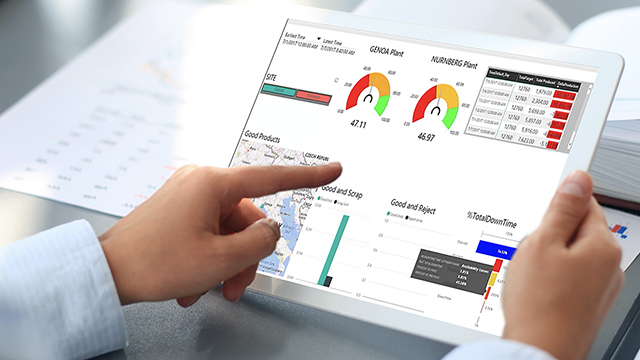
Manages formulations, specifications, samples, testing and laboratory decisions within a controlled data flow.
Explore the product →Opcenter executes the planned process on the shop floor, makes deviations visible as they occur and feeds confirmed results back to enterprise systems. This makes as-planned and as-built data directly comparable.
Products, routes, materials and competencies are verified.
→Instructions are executed and shop-floor events are recorded.
→Results are checked against limits and specifications.
→Losses are analysed to improve plans and operating standards.
Product families, operations, data-capture points and loss categories are mapped.
Roles, workflows, data ownership and success indicators are agreed together.
ERP, PLM, automation, laboratory and identity systems are positioned within the architecture.
An end-to-end scenario is validated on a representative line or product family.
Templates, integrations and training materials are made reusable.
Coverage is expanded across the plant, while performance data enables new use cases.
Complex assembly, product variants, serial/lot traceability and operator guidance.
Formulas, recipes, batches, consumption, process parameters and electronic batch records.
NPI, SMT, component traceability, machine connectivity and quality control.
Audit trails, electronic signatures, specifications and controlled deviation management.
Customer and facility information has been anonymized to meet confidentiality obligations.
 ANONYMOUS PROJECT
Fragmented control practices were unified through a standard PLC/HMI architecture, controlled operating modes and verifiable safety functions.
Read the story → ANONYMOUS PROJECT
Paper and disconnected production records were unified through guided execution, electronic batch records and auditable data integrity.
Read the story → ANONYMOUS PROJECT
Machine settings and quality evidence were connected through product recipes, coil identity and traceable process records.
Read the story →We will review your current systems, priority use cases and integration needs with the relevant engineering team.
Request an MES fit assessment Your request is routed directly to the relevant engineering team.
Engineering confidence with Oskon.
Leave your details and our expert engineers will contact you for a preliminary consultation tailored to your needs.